
Best Stair Lifts of 2026: An Honest Comparison for Aging in Place
An honest 2026 guide to the best stair lifts: real installed costs, straight vs curved, the staircase width you need, power-outage facts, and who pays.

The brands compared at a glance
1
Acorn StairliftsAn affordable straight-stair lift, installed fast
- Straight and curved rails
- 280 lb capacity (up to 350 lb)
- Battery backup keeps working in an outage
- Folding rail available; 12-month warranty
2
Stannah StairliftsPremium build with ongoing service
- Straight and curved rails
- 350 lb capacity (straight)
- Folding rail standard; optional powered swivel
- 2-year warranty plus annual service
3
Bruno Stair LiftsHigher capacity and a lifetime motor (indoor)
- Straight and curved rails
- 300 lb (Elan) or 400 lb (Elite)
- Battery backup (about 10 to 15 trips)
- Limited lifetime motor warranty on indoor lifts
4
Harmar Stair LiftsThe heaviest-duty option (up to 600 lb)
- Straight and curved (Helix) rails
- 350 lb, or 600 lb on the SL600HD
- Long battery backup (up to 60 trips on indoor models)
- Powered folding rail and interlock swivel options
5
Handicare / Savaria StairliftsA curved-rail option with solid capacity
- Straight and curved rails
- 350 lb (up to 400 lb on the K2 Plus)
- Battery backup; folding rail standard
- 24 to 36 month warranty
ElderHearth offers general information, not medical, legal, or financial advice. Stair lift prices change often and depend on your staircase. Confirm the current price and specs on the manufacturer's own site before you buy.
When the stairs become the hardest part of a parent's day, a stair lift is often what lets them keep the whole house, and their independence, instead of moving a bed into the dining room or leaving home altogether. Choosing one without getting lost in jargon and call-for-a-quote pricing is where it gets hard. This is an honest comparison of the best stair lifts in 2026: what they really cost installed, how to tell which one fits your staircase, the power-outage facts the brochures skip, and who can help pay.
The short answer: which stair lift is best?
There is no single best stair lift, only the best one for a specific staircase and a specific person. The quick version:
- Best for a standard straight staircase: a quality straight lift from any major brand (Acorn, Bruno, Stannah). These are the most affordable and install in a day.
- Best for stairs with a turn or landing: a curved lift, custom-built to your rail. It costs far more, but it is the only thing that fits a bend.
- Best for a heavier or taller parent: a heavy-duty model, such as the Harmar SL600HD (600 lb) or a Bruno Elite (400 lb).
- Best for a narrow or older staircase: a compact model with a folding rail, which frees the walkway for everyone else.
- Best for a short-term need, like recovery after surgery: a rental, not a purchase.
- Best on a tight budget: a reconditioned straight lift, plus a check of the programs that help pay.
The rest of this guide shows the real numbers and how to choose with confidence.
Straight or curved: the choice that drives everything
Almost every other decision, including price, follows from one fact about your stairs.
- A straight stair lift runs in a single straight line with no turns. The rail is mass-produced and cut to length, so it is cheaper and can usually be installed within a day or two.
- A curved stair lift is for staircases with a bend, a corner, or a mid-flight landing. Each rail is custom-built to the exact shape of your stairs, which is why it costs more and takes weeks to manufacture.
If your staircase has even one turn, you need a curved lift. There is no straight-lift workaround that is safe. Measure honestly before you price anything.
How much does a stair lift cost in 2026?
Realistic installed prices in the United States, gathered from the National Council on Aging and major manufacturers, run as wide ranges. Treat them as ranges, not quotes: your final price depends on your stairs, your options, and current promotions.
| Type | Typical installed price | Notes |
|---|---|---|
| Straight stair lift | $2,500 to $7,500 | Most fall in the $2,500 to $5,000 range; features push the top end up |
| Curved stair lift | $8,000 to $20,000 or more | Custom rail; each additional turn or landing adds cost |
| Reconditioned straight lift | $1,500 to $3,000 | Often equipment only; installation may add $500 to $2,000 |
| Rental (short-term) | $200 to $500 per month | Usually a 3-month minimum; see below |
A few honest notes on curved stair lift cost: the wide range is real, because a single gentle bend is far cheaper than two turns and a landing. Get the quote in writing, ask whether removal and resale are included, and remember that a curved rail is custom, so it rarely transfers to another home. For the full picture of what a lift adds to your monthly and one-time costs, our aging-in-place cost calculator lets you add it alongside other home modifications.
What size staircase do you need for a stair lift?
This is the question families forget to ask until the installer is standing in the hallway, and it is where a lot of cheaper guides go quiet.
Most stair lifts need a staircase that is roughly 27 to 30 inches wide: about 28 inches for a standard straight lift, closer to 30 for a curved one, and as narrow as 27 inches for a compact model. Width is measured to the nearest obstruction, so handrails, baseboards, and molding count against you. A 30-inch staircase with a chunky handrail may have less usable width than the tape measure suggests.
Two more clearances matter as much as width:
- Bottom landing: you need roughly 18 to 24 inches of flat floor at the foot of the stairs for the parked chair and footrest.
- Top landing: enough room to fold the chair and step off safely onto level ground.
When the chair is folded against the wall, a slim model sits only about a foot from the wall (the rail itself just a few inches), which keeps the stairs usable for everyone else in the house. If two people need to pass on the stairs regularly, a folding rail at the bottom is worth asking about.
How do I measure my stairs for a stair lift?
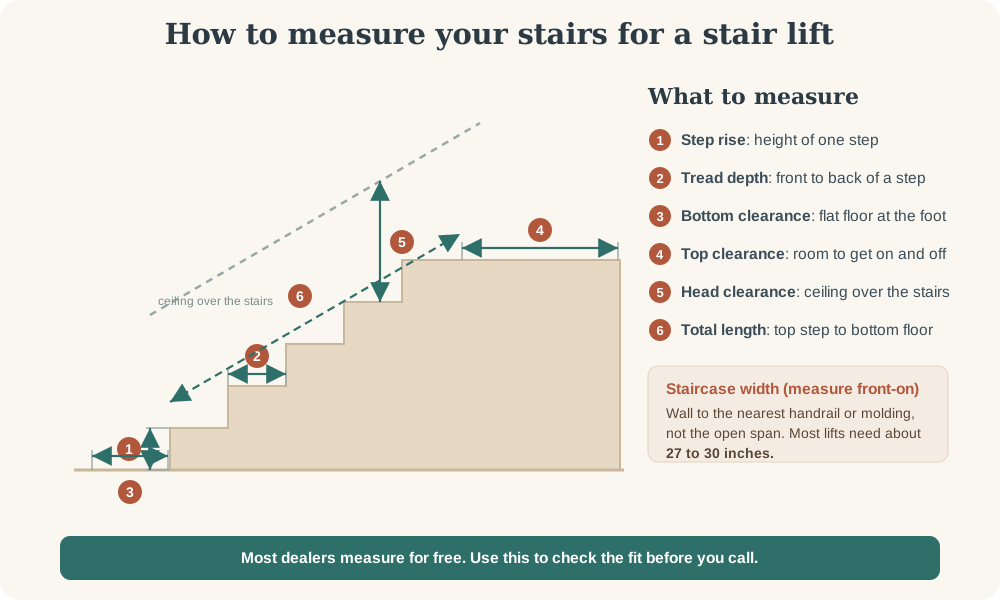
You can take rough measurements yourself to know whether a lift is even feasible, but the final, safety-critical measurement should be done by the dealer, who almost always offers a free in-home assessment. To size things up yourself, measure:
- Total length from the top step down to the floor at the bottom.
- Staircase width, baseboard to baseboard, at the narrowest point.
- The rise (height) of one step and the depth of one tread.
- Bottom clearance: the flat floor beyond the last step.
- Top clearance: room to fold the chair and step off.
- Head clearance if the ceiling is low over the stairs.
- Which side you want to mount the lift, away from doors where possible.
If your numbers are close to the minimums above, do not guess. Book the free measurement and let a professional confirm the fit.
Which stair lift is best for a narrow staircase?
A genuinely narrow or older staircase does not rule out a lift, it just narrows your choices. For a stair lift for narrow staircase situations, look for three things: a compact model rated for the lower end of the width range (around 27 inches), a chair whose arms, seat, and footrest fold flat against the wall, and an optional folding rail that retracts the bottom of the track so it does not jut into a doorway or walkway. Most major brands offer at least one slim model built for exactly this. If your stairs are both narrow and curved, you are firmly in custom-curved-lift territory, and an in-home assessment is the only way to confirm the fit.
Do stair lifts work during a power outage?
Yes, and this is one of the most reassuring facts about modern lifts. Nearly every stair lift today runs on rechargeable batteries (DC power), not directly on household current. The wall outlet simply keeps the batteries charged while the chair is parked. So when the power goes out, the lift keeps working.
How long? The honest answer is that backup is measured in trips, not hours, usually around 10 to 20 round trips on the reserve charge, though it varies by model: Bruno cites roughly 10 to 15 trips for an outdoor lift, while Harmar rates its SL600 for up to 60 cycles. So if you are wondering do stair lifts work in a power outage, the answer is yes, with enough reserve to get your parent up or down safely several times until power returns. One exception worth checking: a few outdoor models run on standard AC power and will not operate in an outage, so confirm the power source if outdoor stairs are involved.
How much weight can a stair lift hold?
Standard stair lifts are typically rated for 250 to 400 pounds, with most landing in the 280 to 350 pound range. That covers the majority of users comfortably.
If your parent is taller or heavier, you want a heavy duty stair lift: heavy-duty (sometimes called bariatric) models extend capacity to roughly 400 to 600 pounds, and they usually add a wider seat and more legroom, which matters as much as the number on the spec sheet. When you compare heavy duty stair lift weight capacity, look past the headline figure to the seat dimensions, because a 600-pound rating on a narrow seat is not a good fit. At the top of the market, the Harmar SL600HD is rated to 600 pounds; Bruno's Elite line and several Savaria and Stannah models reach 350 to 400 pounds.
What accessories make a stair lift safer and more comfortable?
The base lift gets your parent up the stairs. The accessories are what make it safe and genuinely pleasant to use, and they are where a little extra spending buys real day-to-day comfort. The ones worth knowing about, all real options across the major brands:
- A powered swivel seat turns the chair toward the landing and locks, so your parent steps off onto level ground instead of twisting on the stairs. This is the single biggest safety upgrade for many people.
- A powered footrest raises and lowers with the seat at the touch of a button, which matters for anyone who cannot bend down easily.
- A retractable seatbelt and obstruction sensors come standard on quality lifts; the sensors stop the chair if it meets a toy, a pet, or a dropped cane.
- Wireless remote controls let a caregiver call or send the empty chair from the top or bottom of the stairs.
- A folding rail retracts the bottom of the track to remove a tripping hazard in a doorway or hall.
- A soft start and stop eases the chair gently into motion and to a halt instead of jerking, which is kinder on stiff joints and easier on nerves.
- Adjustable seat height (often more than four inches of range) makes standing up at the end of the ride much easier.
If budget is tight, prioritize the powered swivel seat and a comfortable, properly sized seat. Those two do the most for safety and dignity.
Can you rent a stair lift?
Yes, and renting is the smart choice for a short-term need: a parent recovering from surgery, a relative visiting for a few months, or a home you plan to leave soon. Rentals typically run $200 to $500 a month with a one-time installation fee and often a three-month minimum, and some companies credit a share of your payments toward a purchase if you decide to keep it. Renting almost always makes sense only for straight staircases, since a custom curved rail is too expensive to install and remove for a brief period.
The best stair lifts compared by brand
How the major brands line up on the specs that matter. Capacities and warranty terms are from each manufacturer's own materials; where a figure is not published, we say so rather than guess. Always confirm current specs and pricing with the manufacturer or a local dealer.
| Brand | Rail types | Weight capacity | Battery / outage | Folding rail | Powered swivel | Outdoor model | Warranty |
|---|---|---|---|---|---|---|---|
| Acorn | Straight + curved | 280 lb (up to 350 lb) | Yes | Available | Manual standard | Yes | 12 months |
| Stannah | Straight + curved | 350 lb (straight) | Yes | Yes | Optional | Yes | 2 years + annual service |
| Bruno | Straight + curved | 300 lb (Elan) / 400 lb (Elite) | Yes (~10 to 15 trips) | Optional | Optional (indoor) | Yes | Limited lifetime motor (indoor) |
| Harmar | Straight + curved (Helix) | 350 lb / 600 lb (SL600HD) | Yes (up to 60 trips) | Optional (powered) | Interlock swivel | Yes (AC, no outage) | Lifetime motor (SL600) |
| Handicare / Savaria | Straight + curved | 350 lb (up to 400 lb, K2 Plus) | Yes | Yes | Optional | Some models | 24 to 36 months |
A few honest caveats: Stannah does not publish a weight capacity for its curved Starla model, and Bruno does not publish seat dimensions, so confirm those directly if they matter to you. A "lifetime motor" warranty is firm from the manufacturer only for Bruno's indoor lifts and Harmar's SL600; for the others, lifetime claims usually come from dealers, not the official warranty, so read the actual terms.
Who pays for a stair lift?
This is the question that decides whether a lift is possible at all, and the news is better than most families expect, as long as you look past Medicare.
Original Medicare (Part B) does not cover stair lifts. It classifies them as home modifications rather than durable medical equipment, so a standard Medicare plan will not pay. We walk through this in detail, including the rare exceptions, in does Medicare cover stair lifts.
The programs that often do help:
- Medicaid home and community-based services (HCBS) waivers explicitly list stair lifts as an environmental accessibility adaptation in many states. This is the most common source of real help.
- Veterans' grants: the VA's Specially Adapted Housing (SAH) and Special Home Adaptation (SHA) grants can fund a lift for a veteran with a qualifying service-connected disability. Note that the smaller HISA grant generally excludes stair glides, so the right path is usually SAH/SHA or Veteran-Directed Care.
- Some Medicare Advantage plans include home-safety benefits that may apply; this is plan-specific and uncommon.
- State and local programs through your Area Agency on Aging often offer grants or low-interest loans.
For a plain-English overview of every funding route, see help paying for a stair lift. For state-specific help, we have detailed guides for stair lift assistance in California, Texas, Florida, New York, Pennsylvania, Ohio, Illinois, North Carolina, Michigan, Georgia, New Jersey, Virginia, Washington, Arizona, Indiana, Tennessee, and Massachusetts, with more states on the way.
How to choose the best stair lifts for your needs
Pull it all together, and the right lift usually picks itself once you are honest about the staircase and the person:
- Standard straight staircase, average-size parent: a straight lift from any major brand. Compare on price, warranty, and how the local dealer handles service.
- Stairs with a turn or landing: a curved lift. Budget accordingly and get the rail measured precisely.
- Heavier or taller parent: a heavy-duty model, and check the seat width, not just the weight rating.
- Narrow or older staircase: a compact model with a folding rail.
- Trouble bending the knees, or standing more comfortably than sitting: ask about a perch (stand-assist) model.
- Short-term need after surgery or a visit: rent rather than buy.
- Worried about outages or rural power: confirm the battery backup and avoid AC-only outdoor units.
- Tight budget: a reconditioned straight lift, paired with the Medicaid, VA, or state programs above.
Frequently Asked Questions
What is the best stair lift? There is no single best stair lift. For a standard straight staircase, any major brand (Acorn, Bruno, Stannah) is a strong, affordable choice. For stairs with a turn, you need a curved lift. For a heavier parent, a heavy-duty model like the Harmar SL600HD. The right pick depends on your staircase shape, your parent's size, and your budget.
How much does a stair lift cost in 2026? A straight stair lift typically runs $2,500 to $7,500 installed, with most around $2,500 to $5,000. A curved stair lift costs $8,000 to $20,000 or more because the rail is custom-built. Reconditioned straight lifts start around $1,500 to $3,000, and rentals run $200 to $500 a month.
Will Medicare pay for a stair lift? Original Medicare does not cover stair lifts, because it treats them as home modifications, not durable medical equipment. Medicaid HCBS waivers, VA grants for eligible veterans, some Medicare Advantage plans, and state or Area Agency on Aging programs can help instead.
What size staircase do you need for a stair lift? Most lifts need a staircase about 27 to 30 inches wide, measured to the nearest handrail or molding: roughly 28 inches for a straight lift, 30 for curved, and as narrow as 27 inches for compact models. You also need flat floor space at the top and bottom to get on and off safely.
Do stair lifts work during a power outage? Yes. Almost all stair lifts run on rechargeable batteries that the wall outlet keeps charged, so the lift keeps working in an outage, usually for about 10 to 20 round trips. A few outdoor models run on AC power and will not work without electricity, so confirm the power source.
How much weight can a stair lift hold? Standard models hold 250 to 400 pounds, most commonly 280 to 350. Heavy-duty (bariatric) models extend to roughly 400 to 600 pounds and add a wider seat. The Harmar SL600HD tops the market at 600 pounds.
Can you rent a stair lift instead of buying one? Yes. Renting suits short-term needs like recovery after surgery, typically at $200 to $500 a month with a three-month minimum. Rentals make sense mainly for straight staircases, since curved rails are custom and costly to install and remove.
A last word
A stair lift buys back something specific: the full use of a home, and the dignity of a parent climbing to their own bedroom instead of giving it up. Choose for the staircase you actually have and the parent you actually have, get the measurements and the price in writing, and lean on the swivel seat and a comfortable seat over flashier extras. Then let the lift become part of the house, quietly making the upstairs possible again.
If you want to tell someone how it is going, you are welcome to write to us.
How we evaluated the best stair lifts
Prices on this page carry their source. We use manufacturer figures where the manufacturer publishes one, pricing guidance from the National Council on Aging and industry dealers where it does not, and program rules straight from Medicaid and the VA. We mark which is which, because a dealer estimate and a published price are not the same kind of number, and some brands publish no figure at all. Confirm with the provider before you commit. See how ElderHearth works for our full method.
Sources
- National Council on Aging, Stair Lift Costs: A Complete Guide and Stair Lift Buying Guide.
- National Council on Aging, Medicare and Stair Lifts and Used Stair Lift Buyer's Guide.
- Harmar, How Much Does a Stairlift Cost and SL600 product page (checked June 2026).
- Bruno, Stair Lift Buying Guide (checked June 2026).
- Arrow Lift, Stair Lift Prices (checked June 2026).
- California Mobility, Stair Lift Space Requirements.
- Medicaid.gov, Home and Community-Based Services Authorities, 1915(c) (stair lifts listed as environmental accessibility adaptations).
- U.S. Department of Veterans Affairs, Disability Housing Grants (SAH/SHA) and HISA Program.