
Help Paying for a Stair Lift: Assistance Programs by State (2026)
Need help paying for a stair lift? Medicaid waivers, the VA, and state programs can help. The four ways to get one covered, plus a state-by-state guide.
ElderHearth offers general information, not medical, legal, or financial advice. Program rules change; confirm current details with the agencies linked below.
If you are looking for help paying for a stair lift (also called a chair lift), start with the one fact that surprises most families: Original Medicare does not cover a stair lift, in any state. But four other routes do, and the biggest is Medicaid. This guide walks through the four ways to get a stair lift covered, then points you to the exact program in your state.
Does Medicare pay for a stair lift?
No. Original Medicare (Part A and Part B) does not pay for stair lifts anywhere in the country. Medicare covers durable medical equipment used for a medical purpose, but it treats a stair lift as a home modification rather than medical equipment, and home modifications are excluded. Some Medicare Advantage (Part C) plans offer limited home-safety benefits, so it is worth asking your plan, but do not count on it. For the full explanation, see our guide on whether Medicare covers stair lifts.
Does Medicaid cover stair lifts?
Yes, for those who qualify, Medicaid can cover a stair lift in most states, through its Home and Community-Based Services (HCBS) waivers. These programs pay for home modifications that keep an older adult out of a nursing facility, and a stair lift often qualifies when it is medically needed, with approval decided case by case. For a low-income older adult, this is the closest thing to a free stair lift for seniors, and it is the main route of the four below. Because Medicaid is run state by state, the program name and rules differ, so check your state's program in the list further down.
Stair lift financial assistance: the four ways to get help paying
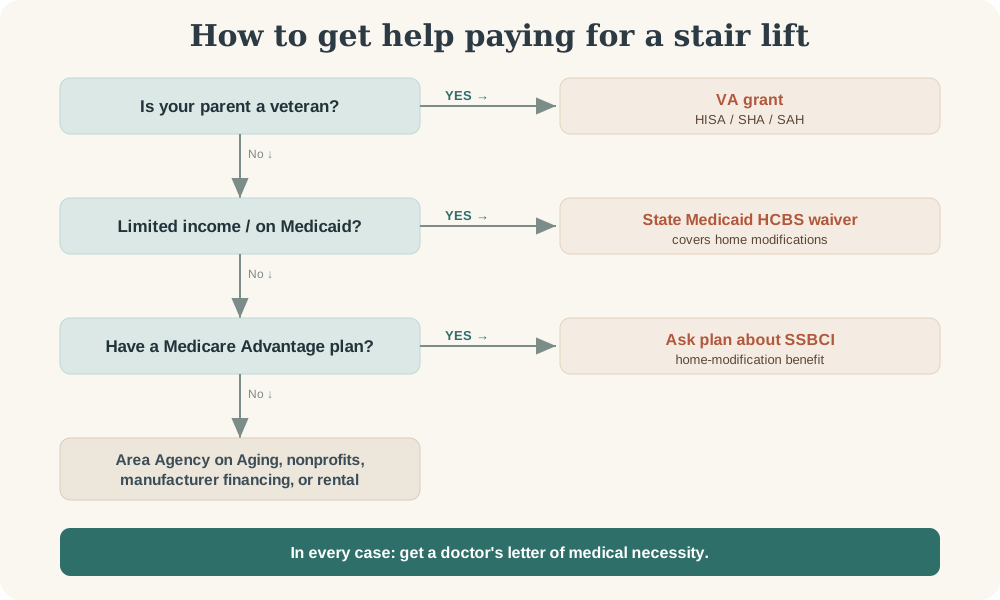
Almost every source of stair lift assistance falls into one of these four buckets. Work through them in order.
1. Medicaid home and community-based services (the main route)
This is where most real help comes from. Every state runs Home and Community-Based Services (HCBS) waivers designed to keep older adults out of nursing homes by paying for supports at home, and home modifications are usually on the covered list. Whether a specific stair lift is approved is decided case by case, based on your parent's assessed needs, so you have to ask.
To qualify in 2026, an applicant generally needs:
- Income up to about $2,982 a month for a single applicant (300 percent of the Federal Benefit Rate), though the exact figure and how it is counted vary by state and program. The Social Security Administration published that rate: "The maximum Federal Supplemental Security Income (SSI) monthly payment amounts for 2026 under title XVI of the Act will be $994 for an eligible individual".
- Assets typically under $2,000 for a single applicant.
- A documented need for nursing-facility-level care.
The program has a different name in every state, which is why the state-by-state table below matters.
2. VA grants for veterans
If your parent is a veteran, the VA offers real money toward home accessibility, and the amounts are in a different league from a repair grant. Ask specifically about Specially Adapted Housing (SAH) and Special Home Adaptation (SHA), the two large grants. Do not spend time on the smaller Home Improvements and Structural Alterations (HISA) grant for this: the VA lists "removable equipment or appliances such as portable ramps; porch lifts, and stair glides" among the alterations HISA excludes. A VA physician's prescription stating medical necessity is required. The FY2026 maximums for the two that apply:
| VA grant | FY2026 maximum | Best for |
|---|---|---|
| SHA | up to $25,350 | Adapting a home for accessibility |
| SAH | up to $126,526 | Major adaptation for severe disabilities |
| TRA | up to $50,961 (SAH-eligible) / $9,100 (SHA-eligible) | Temporary residence |
3. Area Agencies on Aging
Every region has an Area Agency on Aging that can screen your parent for programs, point you to the right Medicaid waiver, and connect you with local help. Reach your area office through the Eldercare Locator at 1-800-677-1116 or eldercare.acl.gov. This is the single best phone call to make if you are not sure where to start.
4. Local nonprofits and charities
When the programs above do not fit, local organizations sometimes fill the gap. Habitat for Humanity affiliates, Rebuilding Together, and community or faith-based groups occasionally help with home safety modifications, and some medical-equipment charities offer reconditioned lifts at low or no cost.
Whichever of the four you pursue, ask your parent's doctor for a letter of medical necessity early. Almost every application above is judged partly on it, and waiting for one is the delay families run into most.
How do you qualify for a stair lift?
There is no single national program and no one income cutoff, because a stair lift (or chair lift) counts as a home modification rather than covered medical equipment. Whether your parent qualifies depends on which of the routes above fits them:
- Medicaid (the main route): a single applicant generally needs income up to about $2,982 a month (2026), under $2,000 in assets, and an assessed need for nursing-facility-level care. The exact limits and how income is counted vary by state and program.
- VA grants: your parent must be a veteran with a qualifying service-connected disability to use the SAH or SHA grant.
- Area Agencies on Aging and nonprofits: eligibility is usually based on age, income, and local rules, and any given home-lift or stair-lift program may set its own criteria.
The fastest way to find out exactly what your parent qualifies for is to call your Area Agency on Aging through the Eldercare Locator (1-800-677-1116) and ask which program in your state covers home modifications.
Who pays for a stair lift? Find help in your state
We have detailed, step-by-step guides for the states below. Each one names the specific Medicaid program, the 2026 income limits, and exactly how to apply. Find your state to see who pays and how:
| State | Main Medicaid route (tap for the full guide) |
|---|---|
| Arizona | ALTCS |
| California | Medi-Cal / CalAIM Community Supports |
| Florida | SMMC Long-Term Care |
| Georgia | CCSP and SOURCE waivers |
| Illinois | Persons who are Elderly Waiver |
| Indiana | PathWays for Aging Waiver |
| Massachusetts | Frail Elder Waiver |
| Michigan | MI Choice Waiver |
| New Jersey | MLTSS / NJ FamilyCare |
| New York | NHTD Waiver |
| North Carolina | CAP/DA Waiver |
| Ohio | PASSPORT Waiver |
| Pennsylvania | Community HealthChoices |
| Tennessee | TennCare CHOICES |
| Texas | STAR+PLUS Waiver |
| Virginia | CCC Plus Waiver |
| Washington | COPES Waiver |
What if my state isn't listed?
The four routes above still apply, and every state runs Medicaid HCBS waivers, they just go by different names. To find yours:
- Call the Eldercare Locator (1-800-677-1116) and ask for your Area Agency on Aging.
- Ask your state Medicaid office about its HCBS waiver for older adults and whether it covers home modifications and a stair lift.
- Get a doctor's letter of medical necessity early; it supports nearly every application.
We are adding new state guides regularly, so check back if yours is not here yet.
How much does a stair lift cost?
Knowing the price helps you weigh assistance against simply buying one. A straight-staircase lift typically runs $2,500 to $7,500 installed, and a curved one $8,000 to $20,000 or more. Renting is an option for short-term needs, often around $200 a month plus installation. To compare models and figure out which lift fits your parent's staircase, see our honest stair lift comparison.
Frequently Asked Questions
Does Medicaid pay for a stair lift? For those who qualify, yes, usually through a state Home and Community-Based Services waiver that covers home modifications to keep someone at home instead of in a nursing facility. Whether a specific stair lift is approved is decided case by case, so ask the care manager directly.
How do I get a free or low-cost stair lift? Start with Medicaid: apply and ask your Area Agency on Aging about the HCBS waiver for older adults and home modifications. Veterans can look at VA SAH and SHA grants, and local nonprofits like Habitat for Humanity or Rebuilding Together sometimes help.
Will Medicare ever cover a stair lift? Original Medicare does not, because it classifies a stair lift as a home modification rather than durable medical equipment. Some Medicare Advantage plans offer limited home-safety benefits, so check with your specific plan.
What is the income limit for Medicaid stair lift help in 2026? For most HCBS waivers, a single applicant can have income up to about $2,982 a month (300 percent of the Federal Benefit Rate), with an asset limit near $2,000. The exact figures vary by state and program, so confirm with your state Medicaid office.
How do you qualify for a free stair lift? A free stair lift almost always comes through Medicaid. A single applicant generally needs income under about $2,982 a month (2026) and under $2,000 in assets, plus an assessed need for nursing-facility-level care; the state's HCBS waiver then covers the lift for those who qualify. Veterans can qualify through a service-connected disability for a VA grant. Call your Area Agency on Aging to find out which program you qualify for.
Are there grants for stairlifts? Yes. For veterans, the VA's SAH and SHA grants can pay toward a stair lift. Beyond that, most "grants" come through Medicaid HCBS waivers, which cover the lift for those who qualify, and occasionally through local nonprofit or community programs. There is no single national stair-lift grant, so start with Medicaid and, for veterans, the VA.
A last word
There is real help paying for a stair lift out there, but almost none of it comes automatically. It comes from making the calls: your state Medicaid office, the VA if your parent served, and the Area Agency on Aging that can tie it all together. A stair lift is one piece of a larger aging-in-place plan; if you would like someone to listen, you are welcome to write to us.
Sources
- Medicare.gov, What Part A & Part B don't cover.
- Medicaid.gov, Home and Community-Based Services 1915(c).
- U.S. Department of Veterans Affairs, Disability Housing Grants (SAH/SHA).
- U.S. Department of Veterans Affairs, HISA Program, including what HISA excludes.
- Eldercare Locator, Area Agencies on Aging.
- 2026 HCBS income limits, Medicaid Planning Assistance.