
Vive Health Review (2026): An Honest Guide by Category
An honest Vive Health review by category: what each range does for an aging parent, the bed rails to skip after two recalls, the return catch and the guarantee.
ElderHearth offers general information, not medical advice. We do not test products. Everything below about Vive Health comes from its own published pages, from the Consumer Product Safety Commission, and from the Better Business Bureau, each linked where it is used.
This Vive Health review is for the family that has just noticed something: a parent who comes back from the store and needs the rest of the afternoon to recover, who has quietly stopped showering, who cannot get up from the sofa without a hand. Vive Health sells the small, specific equipment those moments call for, in ten categories, direct from its own site and through Amazon. This review is written the way a family meets the company, one product at a time, so it works category by category: what each one is for, the signs that a parent has reached it, and the number on the product page that matters. It then names the one category to buy elsewhere, and walks through the two policies that decide whether a purchase goes well: the return rules, which are hard on bathroom items, and the guarantee, which depends on where you bought.
One thing to clear up first, because search engines mix them: Vive Health is a medical equipment company in Naples, Florida. Viva Health is a health insurer. Nothing below is about insurance.
ElderHearth earns a commission on the Vive Health links in this guide, at no cost to you. The products named are common options for each situation, not a ranking, and each one's specifications come from its product page.
Vive Health review at a glance
| What we looked at | Where it lands | Why |
|---|---|---|
| Range | Wide | Ten categories, from a button hook to a power wheelchair, sold under the company's own labels (Vive Mobility, Vive Precision, ViveSole, Arctic Flex, Xtra Comfort on its brands page) |
| Delivery | Fast, US only | Free standard shipping from $39, one to two business days, continental 48 states, no PO boxes |
| Returns | Tight on the products you will buy first | 30 days, but opened bathroom safety items, braces, pads and cushions are not returnable as of right |
| Guarantee | Real if you buy direct | Automatic on vivehealth.com; Amazon purchases must be registered within 30 days, and only from the Vive storefront |
| Safety record | One category to avoid | Adult bed rails recalled twice in 2026, two deaths in the second recall; other categories not involved |
| Paying for it | Cash or card | Vive does not take Medicare, Medicaid or HSA cards; PayPal financing on eligible items |
Each row is expanded below with the policy text it comes from. The short version: a good place to buy a grab bar, a walker or a gait belt if you measure first and buy direct, and not a place to buy a bed rail.
What Vive Health sells, and the moment a parent reaches each category
A parent rarely announces that they need equipment. They say the store was tiring, or that their knee hurts by afternoon, or they simply stop doing something they used to do. Each category below starts with those signs, because that is how families actually arrive at it.
Power mobility. The signs: a trip to the supermarket needs the rest of the day to recover from; walking two hundred yards means finding somewhere to sit; the daily walk to the park has quietly stopped, and grocery runs have been handed to a son or daughter. Vive's scooters and power wheelchairs run from three-wheel and folding travel scooters to full power chairs, its most expensive category. Our best mobility scooters guide compares the types, and does Medicare cover a wheelchair? explains where a scooter falls under Medicare's rules.
Walking aids. The signs: walking feels unsteady, the first steps after standing wobble, and at home the route to the kitchen goes hand over hand along the furniture; at night the glass of water is skipped rather than fetched. The canes, walkers and rollators range includes the upright walker described below. Best rollators for seniors sorts the types, and does Medicare cover a walker? covers the prescription route.
Transfers and standing up. The signs: sitting down is fine but getting up takes three tries; a parent's shoulder hurts after being pulled up; the caregiver's own back hurts, and every move from bed to chair is tense. The transfer belts and lift aids range runs from a gait belt to a home patient lift. The technique, which matters more than the equipment, is in how to safely lift an elderly person.
Bathroom. The signs: standing in the shower is exhausting, the leg will not clear the tub wall, the toilet is too low to get up from; showers become less frequent and a wash at the sink takes their place. The bathroom safety range is where this guide's five situations begin and where the return rule bites hardest. Bathroom safety for seniors has the placement rules; toilet height for seniors explains the seat height.
Bedroom and nighttime. The signs: dizziness on getting up at night, soreness over the hips and heels after long hours in bed, a fear of falling with no one hearing; fluids are cut in the evening to avoid the trip. The bed and bedroom safety range includes bed and chair alarms, fall mats and alternating pressure pads. It also includes bed rails, which are the subject of the recall section below. Pressure sores in the elderly covers what the pads are for.
Daily living aids. The signs: bending to put on socks brings on dizziness, buttons are beyond stiff fingers, a spoon is hard to hold; the wardrobe narrows to pull-on clothes, socks are skipped, meals spill, pills get missed. The daily living aids range is the small, inexpensive equipment: dressing sticks, sock aids, button hooks, weighted utensils, reachers, pill organizers. Gifts for someone with arthritis in their hands and how to organize an elderly parent's medications cover the same ground from the family's side.
Home health monitoring. The signs: dizziness, a racing heart, swollen ankles, a thirst that will not go away; a blood pressure pill missed here and there, weight creeping up, and a son or daughter in another state who cannot get a number over the phone. The health monitoring devices range is blood pressure monitors, pulse oximeters, scales, thermometers and glucose monitors under the Vive Precision label. What the readings mean is in high blood pressure in older adults and heart disease in older adults.
Braces and supports. The signs: knees that hurt on the stairs, a back that aches after standing at the stove, ankles that swell by evening and socks that leave a ring. The braces and compression range covers knee, back, ankle, wrist and compression socks. A brace is a support, not a diagnosis; arthritis in older adults is the page to read before deciding a knee that hurts every day is a brace problem.
Foot care. The signs: heel pain on the first step of the morning, a bunion rubbing in every shoe, calluses that hurt to walk on, toenails a parent can no longer reach; shoes bought a size larger, and less walking. The foot care range is insoles, heel cups, bunion splints, toe separators and long-handled tools. For a parent with diabetes, our foot care for the elderly guide sets out what should never be self-treated.
Rehabilitation and exercise. The signs: after a hospital stay the legs have no strength, balance is poor and joints are stiff; the therapist visits once a week and the other six days go unused because the parent is afraid to practice alone. The physical therapy equipment range includes balance discs and boards, resistance bands, pedal exercisers, grip strengtheners, TENS units and hot and cold therapy. Fall prevention exercises for seniors is the routine most of it supports.
Two categories deserve a word on limits. A TENS unit and a brace are both things a doctor should know about before a parent uses them daily; and everything in the bathroom and bedroom rows should be measured against the actual toilet, tub and bed before it is ordered, because of the return rule below.
Vive Health products fit five situations, and one you should skip
The five, in the order they usually arrive: a parent who can no longer get up from the sofa without help; a parent who has stopped showering because getting in and out is frightening; nighttime bathroom trips that end in a fall; a parent who refuses a walker; and a caregiver whose back is giving out from lifting. Each has a section below with the product that fits and the number on its product page that matters.
The one to skip is bed rails. Vive Health recalled its adult portable bed rails twice in 2026, and the second recall involved two deaths. That section is below the five, and it is the reason this guide does not link to a bed rail.
A parent who cannot get up from the sofa needs a stand assist rail before a lift chair
The first thing to go is usually the push up from a low, soft seat, and the first instinct is to shop for a lift chair. A stand assist rail is the cheaper step to try first. Vive Health's stand assist handrails are two padded handles on a frame that slides under or around the seat cushion and locks in place, with no tools and no drilling. The product page lists a 300-pound capacity and handles that adjust between nine and twelve inches. It works on a sofa, loveseat or recliner, and it comes out again if the furniture changes.
The rail solves the leverage problem. It does not solve weakness, so if your parent still cannot rise with two solid handles to push on, that is the point at which a lift chair or a physical therapy referral is the right next call rather than a bigger rail. Our guide to how to safely lift an elderly person covers what to do in the meantime.
Getting in and out of the shower is where bathroom falls start, and three items fix it without a contractor
Many bathroom falls happen stepping over a tub wall or turning on a wet floor, and the fix is three pieces rather than a renovation. First, a bar to hold. Vive Health's screw-in stainless grab bar is rated on its product page to 440 pounds and ships with six screws and six wall anchors. The page is also clear about what it is not: it installs with screws only, so this is not a suction bar, and it still needs to land on a stud or on blocking behind the tile. Have whoever installs it find the stud first; the anchors are for drywall, not for the load.
Second, somewhere to sit. A shower chair turns a standing task into a seated one, which removes the balance problem entirely. Third, a way to wash while seated: a handheld shower head with a hose replaces the fixed head and reaches the person rather than asking them to reach it. The three together are the same list we give in the best walk-in showers for seniors for anyone not replacing the shower this year, and the placement rules are in bathroom safety for seniors.
Read the return policy section below before ordering the chair. It matters more for bathroom items than for anything else Vive sells.
Nighttime bathroom trips are the second fall scene, and seat height is the fix
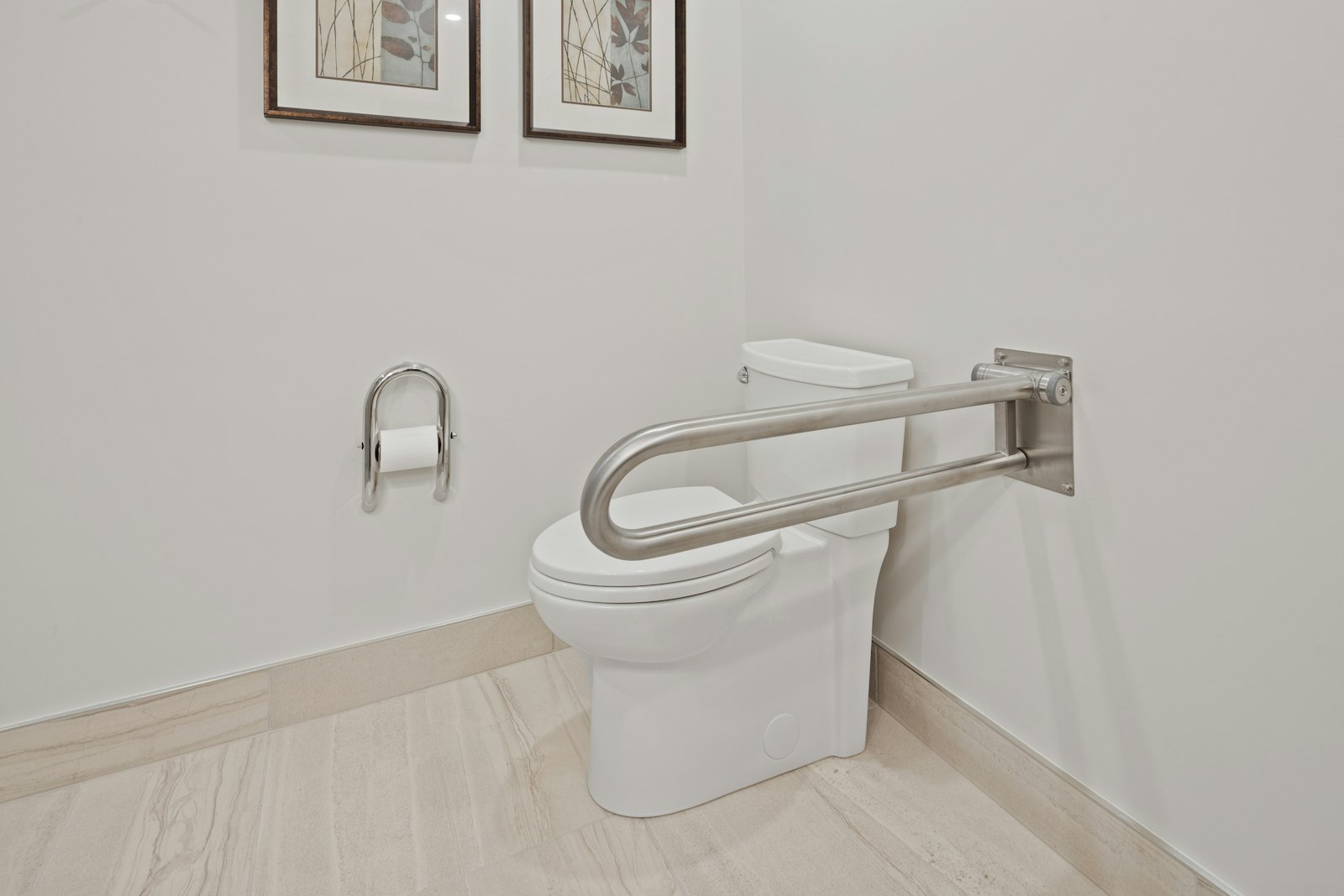
A standard toilet sits low, and a parent who gets up twice a night in the dark with stiff knees is doing a deep squat each time. The 2010 ADA standard puts an accessible seat at 17 to 19 inches; our guide to toilet height for seniors has the citation and the reasoning. Two Vive Health products move an existing toilet into that band without replacing it. A raised toilet seat with handles adds height and two arms to push on. A toilet safety frame leaves the seat alone and puts a rail on each side, which suits a parent whose problem is the push up rather than the height.
Which one depends on what your parent complains about. A complaint that the seat is too low points to the riser; a complaint of having nothing to hold on to points to the frame. A parent recovering from a hip fracture often needs both for a few months, which is a situation our hip fracture recovery guide covers in more detail.
A parent who refuses a walker may accept the Vive Health upright walker, because it does not look like one
The walker refusal is often less about balance than about what the thing says. The standard four-wheel rollator says hospital. The Vive Health upright walker says something else, because the person walks inside it with their forearms on padded rests and their head up. The product page describes it as built to keep the posture upright rather than hunched over the handles, with armrests that adjust between 41 and 46 inches, a padded seat with a backrest for resting, and hand brakes. It is listed at a 300-pound capacity and a weight of 20 pounds.
The trade is that it is bigger and heavier than a basic rollator, so it suits a house with room to turn and a parent who will use it daily rather than fold it into a car twice a week. For that second parent the ordinary rollator with a seat and brakes is the lighter answer. How to get to yes at all is a different problem from which model, and it is the subject of how to convince an elderly parent to use a walker; our best rollators for seniors guide sorts the types.
The caregiver's back is the sixth patient, and a gait belt is the cheapest protection
Every transfer done by grabbing a parent under the arms costs the caregiver's back and the parent's shoulders. A gait belt fastens around the parent's waist and gives the helper handles at the right height. Vive Health's gait belt with padded handles is the direct-from-maker version of the item we describe in how to safely lift an elderly person, where the technique matters more than the brand. Buy the belt before the back goes, not after.
Vive Health bed rails were recalled twice in 2026, and that is the one category to buy elsewhere
This is the section that answers "is Vive Health legit" honestly. The company is real and has been in business since 2014, but in 2026 the Consumer Product Safety Commission announced two recalls of its adult portable bed rails.
The first, on February 19, 2026, covered about 12,355 units. The CPSC notice lists "Incidents/Injuries: None reported" and gives the manufacturer as "Ningbo Shenyu Medical Equipment Co., Ltd., of China" with "Importer(s): Vive Health LLC, of Naples Florida". The second, on March 26, 2026, was larger. Per the CPSC notice, "Units: 122,000", and: "Vive Health has received two reports of entrapment deaths associated with one model of the recalled bed rails. The deaths occurred in September 2024 and involved a 97-year-old man at an assisted living facility in Texas and a 93-year-old man at his home in Florida." The rails "were sold from September 2019 through December 2025 for between $45 and $90."
Vive Health's own recall page explains the defect: the rails "do not comply with the federal safety standard for adult portable bed rails (16 CFR part 1270) because, when attached to a bed, users can become entrapped within the bed rail or between the bed rail and the side of the mattress, posing a serious entrapment hazard and risk of death by asphyxiation." That standard is the Safety Standard for Adult Portable Bed Rails at 16 CFR Part 1270, which by its own text "establishes a consumer product safety standard for adult portable bed rails manufactured after August 21, 2023", the same date the recall notices use as their cutoff. The remedy, per the same recall page, is a refund: "Stop using the Vive Health Bed Rail immediately and remove the bed rail from the bed", mark it RECALLED, photograph it, and email the photo to recalls@vivehealth.com. If a Vive bed rail is already in your parent's house, that is the procedure, today.
Two things follow. The CPSC notices answer the "where are Vive Health products made" question for this category: the rails were made in China and imported. And a company that recalled 134,000 units in two months is a company whose bed rails we will not link to, whatever its other products are like. The five categories above are not covered by either recall.
The Vive Health return policy has one catch that hits bathroom products hardest
Vive Health's shipping and return policy gives "All purchases have a 30-day return window", and then the sentence that matters for this guide: "Any products that may come into contact with bodily fluids are not able to be returned nor refunded when opened due to health risks. Products include but are not limited to bathroom safety, braces, mattresses, pads, cushions." A shower chair or a raised toilet seat that turns out to be the wrong size is, once opened, reviewed case by case rather than returned as of right. So measure first: the toilet bowl shape, the tub wall height, the width of the shower.
The rest of the policy, from the same page: "A return must be authorized by our support team in order to be eligible for a return", the "Issue must be confirmed with a Vive Health product expert using photos or videos for a refund request to be considered", "Shipping charges are non-refundable", the customer pays the return label, and "items equal to or greater than 20lbs will be charged 20% restocking fee". The upright walker is 20 pounds. Cancellation is possible only "within 2 hours of placing your order", and a refund "can take up to 4 weeks" to reach the card. The authorization line is 1-800-487-3808.
None of that is unusual for medical equipment sold online; our RehabMart review describes a specialty retailer that will not take scooters or beds back at all once delivered. It is simply the case that the products most families buy from Vive first are the ones with the least return room, which is why this guide asks you to measure.
The Vive Health guarantee only counts if you bought from the right place
Vive Health's guarantee policy is where buying direct or from Amazon stops being a matter of price. The page says "Only products purchased through ViveHealth.com are automatically registered in our guarantee program. Purchases through 3rd party channels are only guaranteed if registered within 30 days of purchase." The authorized channels are its own site, "Amazon.com: Vive Health Direct" and "Walmart.com: Vive Health"; the policy adds that "Products purchased used or through unauthorized resellers are not covered." So an Amazon listing sold by a different seller carries no Vive guarantee at all, and one sold by Vive Health Direct carries it only if you register within a month.
Three more lines from the same page set expectations. "Each purchase can only receive one guarantee redemption." "The term 'Lifetime' means the estimated lifetime of the product covered within the specific warranty." And "Customers must report any issues with any product within the first 30 days of purchase." The guarantee length itself varies by product, from 30 days to what the page calls lifetime, and is printed on each product page.
On shipping, the policy lists "Free standard shipping on all orders $39+", delivery in "1-2 business day", and a limit to "the continental United States (48 States)" with no shipping to "PO Boxes or Amazon Lockers".
Is Vive Health legit: the company record
Vive Health, LLC is at 8955 Fontana Del Sol Way in Naples, Florida, the address on both its recall page and the CPSC notices. Its Better Business Bureau profile lists the business as started in May 2014 and BBB accredited since May 2016, with a B+ rating, 14 complaints closed in the last three years, and several hundred customer reviews. The BBB page blocks automated access, so those figures are as read on the page rather than quoted, and worth confirming yourself before a large order. Its customer line, 800-487-3808, is advertised as staffed around the clock.
Put together: an established company, direct sales with fast shipping, a guarantee that is real when you buy through the right door, a return policy that is tight on the exact products this site's readers buy, and a serious recall in one product category that the company and the CPSC have documented in full. That is enough to buy a grab bar or a walker from with open eyes, and enough to buy a bed rail from someone else.
Frequently Asked Questions
Is Vive Health legit? Yes, as a company: Vive Health, LLC has operated from Naples, Florida since 2014 and is BBB accredited. Its adult portable bed rails were recalled twice in 2026, with two deaths reported in the second recall, so that product category is the one to avoid. The recalls do not cover its bathroom safety, walker or transfer products.
What is the Vive Health return policy? Thirty days from purchase, with an authorization from support first and photo or video confirmation of the issue. Shipping is not refunded, the customer pays for the return label, items of 20 pounds or more carry a 20 percent restocking fee, and opened bathroom safety, brace, mattress, pad and cushion products are not returnable as of right.
Where are Vive Health products made? The recalled bed rails were manufactured by Ningbo Shenyu Medical Equipment Co. of China and imported by Vive Health LLC, according to the CPSC notices. Vive Health does not publish country of origin for its other products on the pages we checked; ask support for a specific item.
Is the Vive Health upright walker worth it over a regular rollator? For a parent who walks daily at home and hunches over a standard walker, the upright design puts the forearms on padded rests and keeps the head up, at 20 pounds and a 300-pound capacity. For a parent who folds the walker into a car several times a week, a standard rollator is lighter and simpler.
Does the Vive Health guarantee apply to Amazon purchases? Only for items sold by the Vive Health Direct storefront, and only if registered with Vive within 30 days of purchase. Items from other Amazon sellers, and used items, are not covered.
Does Vive Health accept Medicare or insurance? No. Vive Health's FAQ answers "Do you accept Medicare or Medicaid etc.?" with "No, we do not." The same page says "We are unable to accept HSA cards or other forms of insurance payment." A family can submit a receipt to an insurer for reimbursement, but the FAQ says that "this process is handled by a third party and has nothing to do with Vive Health." Financing is available through PayPal on eligible items.
A last word
Buy from Vive Health the way you would buy from any direct seller of medical equipment: measure before you order, register the guarantee the week it arrives, keep the box until you are sure, and put the return authorization number on the calendar at day 25. And if there is a Vive bed rail on your parent's bed right now, take it off tonight and start the refund; the company will pay you to do it. The rest of a safer house is in our aging-in-place plan, and if you want a second reader on a shopping list before it goes in the cart, write to us.
Sources
- Vive Health, Shipping and Return Policy.
- Vive Health, Guarantee Policy and FAQ (payment methods, Medicare and insurance).
- Vive Health, Product Recalls and Recall notice, models LVA1024, LVA2009SLV and LVA2097SLV.
- U.S. Consumer Product Safety Commission, Vive Health Recalls Adult Portable Bed Rails, February 19, 2026 and March 26, 2026.
- eCFR, 16 CFR Part 1270, Safety Standard for Adult Portable Bed Rails.
- Better Business Bureau, Vive Health, LLC profile.
- Vive Health product pages for the stand assist handrails, grab bar, shower chair, handheld shower head, raised toilet seat, toilet safety frame, upright walker, rollator and gait belt (linked in the text; specifications as published there on September 16, 2026).